
Walk down the aisle of a suburban grocer in Sydney's west, Melbourne's south-east or Auckland's Dominion Road today, and you'll hear more languages than English.
That's not a novelty. It's the market.
Nearly half of all Australians have a parent born overseas, and Mandarin, Cantonese, Vietnamese, Arabic and Punjabi are among the most common languages spoken at home outside English, according to the latest ABS Census data.
Multicultural Australia isn't an emerging trend anymore. It's the customer base.
For a long time, retail technology treated language as an afterthought. Maybe it was a translated line on a receipt or a welcome sign at the front of the store.
But the businesses living this shift every day need more than that. And increasingly, these aren't the same businesses they were a generation ago.
A new generation is taking the reins
Across Australia and New Zealand, we're seeing a distinct pattern. Second-generation owners are taking the reins. They’re highly educated, commercially ambitious and deeply connected to both their heritage and the broader market.
They’re stepping into businesses their parents built from nothing, but they’re not content to run the store the way it’s always been run. They want modern systems, better data and a shopping experience that reflects who their customers actually are today.
That customer base is changing too. Asian grocers continue to serve communities looking for familiar products and ingredients, while also attracting more customers from outside those communities who are discovering and cooking with Asian food for the first time.
That changes what these stores need from their systems. It’s no longer enough to serve one established customer base well. They’re serving people who may know the product by its Chinese name, people discovering it for the first time in English, and plenty of customers somewhere in between.
The challenge is making the store clear and accessible to all of them, whichever language they read first.
The challenge is making the store clear and accessible to all of them, whichever language they read first.
Multi-language support that goes further than the receipt.
This is the gap Surefire Systems has set out to close.
Our latest POS capability takes multi-language support beyond the transaction slip and onto the shelf. It now covers both formats grocers actually use: printed shelf labels and electronic shelf labels (ESL).
But the functionality goes deeper than what the customer sees.
Stores can also save alternative product descriptions and supplier details in different languages, giving retailers more flexibility in how multilingual product information is managed throughout the system.
In practice, that means:
Receipts that print in a customer's preferred language, not just English.
Printed shelf labels generated directly from the POS in multiple languages, so product names, descriptions and pricing are easier to understand.
Electronic shelf labels that update in real time, in multiple languages, whenever pricing or promotions change. No reprinting, no delay and no inconsistency between the ticket and the till.
Alternative product descriptions and supplier details stored in different languages, extending multilingual support beyond the customer-facing parts of the store.
For a grocer stocking hundreds of imported lines, many with no obvious English equivalent, this matters enormously.
It can be the difference between a customer guessing what they're looking at and knowing exactly what they're buying.
Chinese and English can sit together on the same label, helping familiar customers recognise the products they know while making those same products easier to understand for someone discovering them for the first time.
Proven where it matters most: on the shop floor
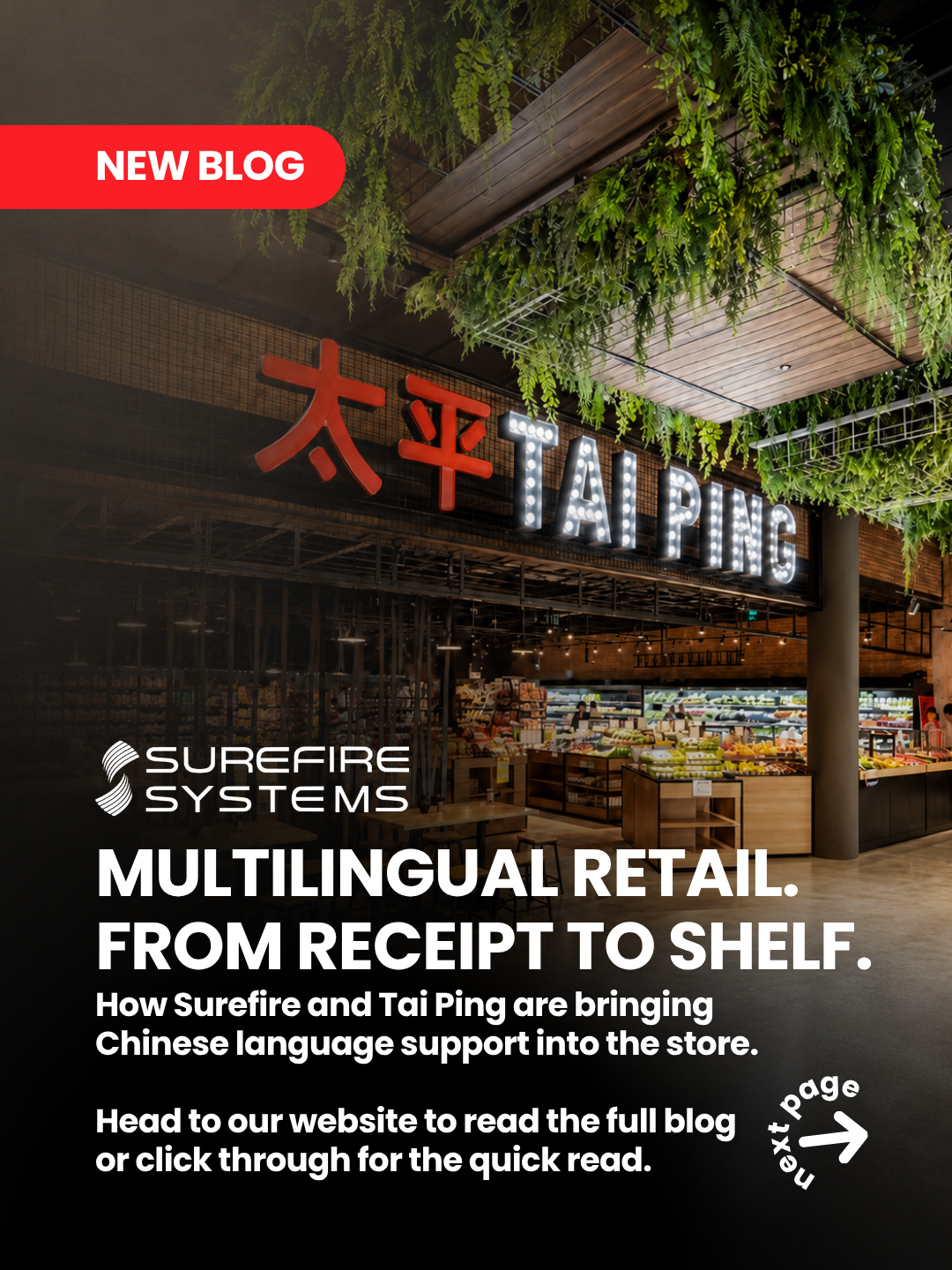
Surefire's first live implementation of multi-language support for Chinese has now gone live at selected Tai Ping stores in New Zealand.
Jordan Chan championed the project from the Tai Ping side and understood what the stores involved in the rollout needed to preserve, but also where there was an opportunity to improve the customer experience.
For long-standing customers, product information needed to remain familiar and easy to recognise. At the same time, Tai Ping's broad range of Asian grocery products needed to be easier to navigate for customers who may be discovering them for the first time.
That made the participating Tai Ping stores a valuable environment to put the capability into practice.
This wasn't multi-language support demonstrated in isolation. It was being used across receipts, printed shelf labels and electronic shelf labels in a real, busy grocery environment, with multilingual product and supplier information sitting behind it as part of the same system.
Putting the capability into a live Tai Ping environment gave Surefire the kind of real-world proving ground this feature was built for.
Why this matters beyond one store
Retailers don't need to guess whether Australia's and New Zealand's grocery customer base is diversifying. The data already confirms it, and the shift isn't slowing down.
But stocking the right products is only part of serving that market.
Customers still need to know what they're looking at. They need to understand the product, the price and the promotion in front of them without having to work it out for themselves.
That's where the systems behind the store matter.
POS, receipts, shelf labels and the product information behind them all form part of the same retail environment. If the customer base speaks and reads in more than one language, the technology supporting that environment needs to be able to do the same.
That's what we've built.
Chinese is the first language we've brought to life across this wider retail journey, with more languages on the roadmap as demand grows.
“For me it's simple: if a customer can't read the label in their language, they're not shopping, they're guessing. Getting that right on the receipt was never the hard part — getting it right on the shelf, in real time, is. Tai Ping proved it works in a real, busy store. Chinese is just the first language. We'll keep adding more.”
— Marc Carswell, General Manager, Surefire Systems
If you're a grocery retailer thinking about how to better serve a multilingual customer base, whether that's your community today or the one you're growing into, get in touch with the Surefire Systems team to see multi-language receipts, shelf labelling and product information in action.